
ATP guide · Bone health
Weight-bearing exercise for stronger bones in Cork
Your GP said weight-bearing exercise. Nobody said what that actually means. This page does, and if you would rather have someone show you, we coach it as personal training at our Douglas and Ballincollig gyms.
What counts
What weight-bearing exercise actually means
It is not just walking. Bone only changes when it is loaded more than it is used to, and that takes a bit of planning.
Walking is a start, not the answer
Walking is weight-bearing, but your bones are used to it. It helps the heart and the head. On its own it does very little for bone density.
Resistance training does the heavy lifting
Squats, hinges, presses and rows with weights that go up over time. This is the type of exercise with the strongest evidence for building bone in adults.
Impact, done carefully
Hopping, step-ups and brisk stairs give bone a useful jolt. How much, and whether at all, depends on your scan and your joints. We tailor it.
Balance is part of the job
A fracture usually starts with a fall. Every programme here includes balance and stability work, because the goal is not falling in the first place.
Progressive, not punishing
Load goes up in small steps, week on week. That steady progression is the signal bone responds to. Nothing here is a bootcamp.
Swimming and cycling do not count
Great for fitness, but the water and the saddle carry your weight for you. Keep doing them for the heart, add lifting for the bones.
The plain version
Weight-bearing exercise for osteoporosis and osteopenia, explained
Weight-bearing exercise is any movement where your bones and muscles work against gravity while you are on your feet. Walking, dancing, stairs, hiking. Resistance exercise is when you work against an added load, like a dumbbell, a barbell, a cable or a band. For bone density the research is fairly clear: resistance training that gets progressively heavier, sometimes combined with a small amount of impact, is what moves the needle. Gentle, steady activity keeps you healthy but does not ask bone to adapt.
That is the bit that usually gets lost between the GP's office and the front door. People are told to do weight-bearing exercise, they take up walking, they do everything right, and the next scan looks the same. It is not their fault. Nobody told them the dose.
What the research points to
The studies with the best results for bone use resistance training at a meaningful load, two or three times a week, focused on the hips, spine and legs, with proper technique and gradual progression over months. Some add short bursts of impact, such as hopping or jumping, where the person's bones and joints can take it. Balance training runs alongside to cut the risk of falls. That is the shape of what we coach, adjusted for the person in front of us.
What to avoid if you have osteoporosis
This is where coaching earns its keep. With osteoporosis in the spine, loaded forward bending and twisting movements are usually avoided. High-impact work is not for everyone. None of this means avoiding the gym. It means someone watching the details so you can train with confidence.
How we coach it at ATP
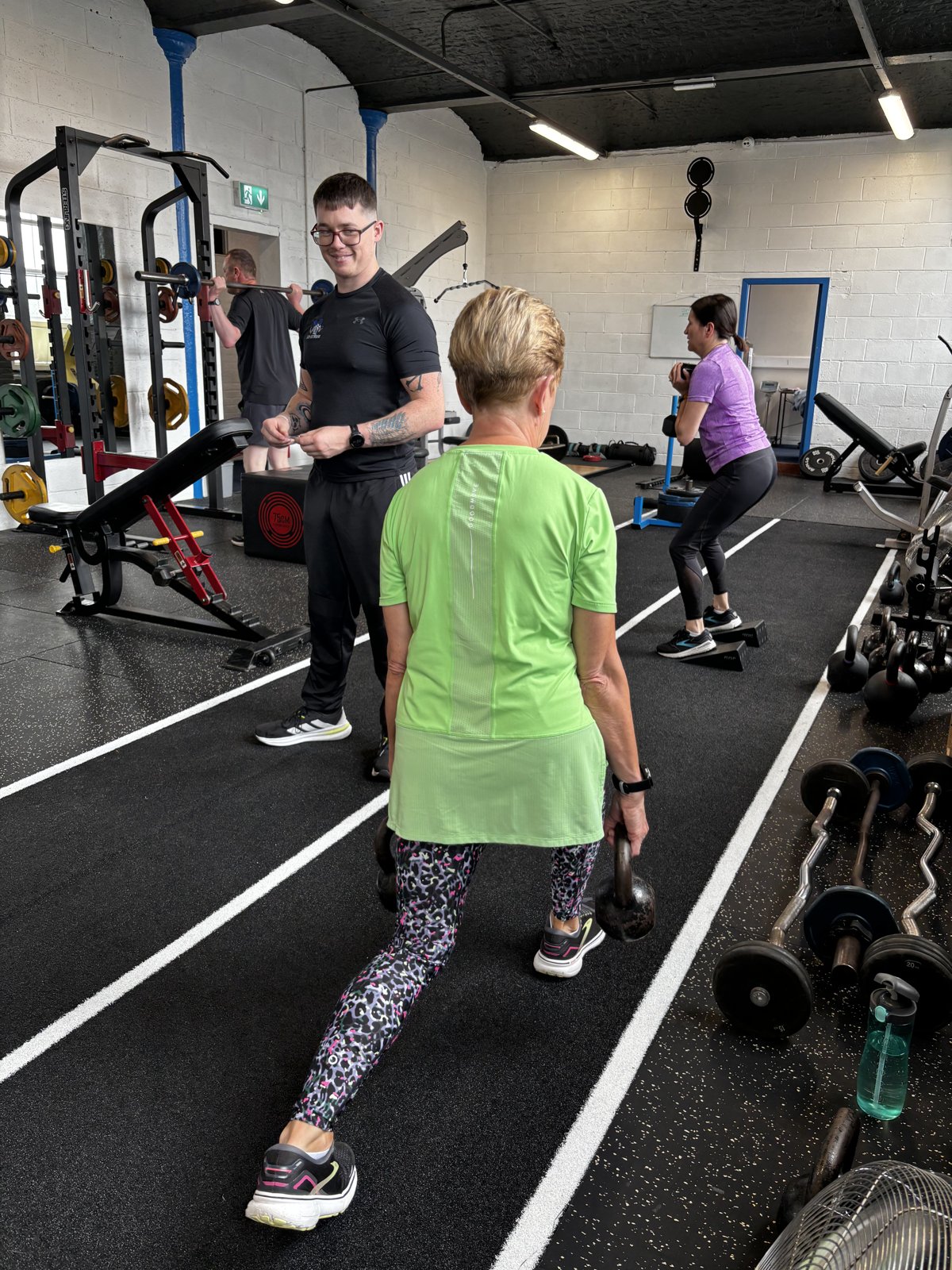
Every session is 1:2, one coach and two clients, each on their own programme. You learn a hip hinge, a squat to a box, a row, a press and a loaded carry with light weights first. Then the load climbs in small steps, session by session. Balance work is in from day one. If your GP, consultant or physio has given you advice, we work to it and build the programme around it. Our bone health page goes into the diagnoses in more detail, our what to do after a DEXA scan guide covers the first month, and if you are in your 60s or beyond our over 60s training page is written for you.
Getting started
Claim your free session below. It is a real coached 30-minute session at Douglas or Ballincollig, not a sales pitch. Mention your bones in the form or when we ring, and we will pair you with a coach who does this every week.
Memberships & pricing
Simple, flexible pricing
Personal training from €20.56 a session on a rolling membership, €35 pay as you go, and no-expiry packs from €289. See full pricing →
FAQ
Weight-bearing exercise questions
If yours is not here, give us a ring. We would rather talk it through.
Is walking enough to improve bone density?
Walking is good for you and worth keeping up, but for most adults it does not load bone enough to increase density. Resistance training that gets progressively heavier is what the research supports. Do both.
What is the difference between weight-bearing and resistance exercise?
Weight-bearing means you are on your feet working against gravity. Resistance means you are working against an added load, like a dumbbell or a cable. Resistance training done on your feet, such as a squat or a deadlift, is both, and it is the most useful kind for bone.
Is swimming or cycling weight-bearing?
No. The water and the bike carry your body weight, so your bones are not loaded. Both are great for your heart and lungs, so keep them, and add strength training for the bones.
How much weight-bearing exercise do I need for osteoporosis?
Two coached strength sessions a week is the sweet spot for most people, with the load increasing gradually over months. Bone adapts slowly, so consistency matters more than intensity on any one day.
Can I do impact exercise like jumping with osteoporosis?
Sometimes, in small doses, and it depends on your scan, your joints and any fracture history. We decide that with you and your GP or physio rather than guessing. There is plenty we can do without it.
Are there exercises to avoid with osteoporosis?
Usually loaded forward bending and twisting of the spine, and high-impact work for some people. Your coach will tell you exactly what applies to you and what to do instead.
How much does it cost?
Rolling memberships start at €179 every 4 weeks for two sessions a week, and our no-expiry packs never lapse. Your first session is free, no card and no commitment.
From our members
From members who started where you are
In their own words, straight from Google.
"I joined ATP because they all say that doing weights is recommended for women who have hit middle age. I wanted to try PT classes because I was a member of another gym for many years but I never challenged myself or followed a structured program. Six months on and I’m stronger, fitter, and have more energy. My mood is better and I’m sleeping better."
"The trainers listened to my reasons for starting & tailored my training plan accordingly. There’s a lovely friendly atmosphere in ATP Fitness & I love the mix of ages. All the trainers are so encouraging & know when it’s time to make changes to the training program. I feel so much stronger now & could not have imagined that I’d have the ability to lift the weights I can today."
"I have been a member of ATP Fitness for a few years now and am glad to say I have never looked back… They know when to push you and when to hold back, when to increase the weights. I feel so much stronger since I started. I would recommend ATP Fitness to anyone and everyone!"
"Lovely welcoming environment! Would definitely recommend the PT sessions, I started a few months ago, having never done any weight training before and I am so glad I did."

Talk to a coach
Want to talk it through?
If you'd like a chat about training around low bone density, leave your details and one of our coaches will give you a ring. No pressure and nothing to sign up to.
ATP Fitness App
Manage your sessions on the go
Book your PT & classes straight from your phone, manage your membership and top up credits any time.


Find us
Two locations across Cork
Douglas
2nd Floor, Unit A1, Donnybrook Commercial Centre, Donnybrook, Cork City
Tel: 087 649 4134
Mon-Thurs: 6:30am - 8:30pm
Friday: 6:30am - 7:00pm
Saturday: 8:00am - 2:00pm
Sunday: Closed
Ballincollig
Unit 1A, Link Road Business Park, Carrigrohane, Ballincollig, Co. Cork
Tel: 085 725 2370
Mon-Thurs: 6:30am - 8:30pm
Friday: 6:30am - 7:00pm
Saturday: 8:00am - 2:00pm
Sunday: Closed